
Most environmental initiatives start with the same challenge:
How do we make the economics work to drive an environmental outcome?
It’s a reasonable question. But it often points in the wrong direction.
Recently, while reviewing material from John Fullerton, founder and president of Capital Institute on regenerative economics, I came across a word (coined by Aristotle) I hadn’t encountered before: chrematistics the pursuit of wealth for its own sake. Today we often treat that as synonymous with economics. But historically, the word economics comes from the Greek oikonomia: the stewardship and management of the household.
That distinction matters.
Because many environmental programs are designed with a chrematistic mindset, focused on generating financial value from a specific intervention. But environmental outcomes rarely emerge from interventions alone. They emerge from systems.
In other words, the real challenge is not just designing a profitable activity, but organizing the household around it.
Most environmental programs begin with one of four entry points:
- A policy requirement. Examples include programs shaped by regulations such as California’s Low Carbon Fuel Standard (LCFS), emerging tax incentives like 45Z, or compliance frameworks that require companies to demonstrate emissions reductions.
- A corporate commitment. For example, a food company announcing a regenerative agriculture sourcing goal, a manufacturer setting a Scope 3 reduction target, or a retailer launching a “sustainable supply chain” initiative.
- A promising intervention or technology. Plant cover crops. Deploy methane digesters. Adopt soil carbon monitoring tools. Improve irrigation efficiency.
- A funding opportunity. A USDA grant program, philanthropic funding for climate pilots, or corporate funding to test a new environmental market.
The starting point varies. But regardless of where a program begins, the same challenges quickly emerge when the systems around the intervention haven’t been fully designed.
Who participates, and what incentives bring them in.
Who ultimately pays for the outcome.
How outcomes are measured and verified.
How data moves between actors.
How value flows through the system in practice.
What mechanisms allow the program to adapt as conditions change.
When these elements remain implicit, even promising ideas stall.
Participation lags.
Coordination costs rise.
Data becomes difficult to collect or trust.
Economic signals fail to reach the actors generating the outcome.
Markets never quite materialize.
Environmental Outcomes Are System Properties
Climate solutions are often framed as technological breakthroughs or policy instruments.
But environmental outcomes rarely emerge from a single innovation.
They emerge from systems of actors coordinating around shared incentives.
Farmers.
Agronomists.
Technology platforms.
Corporations.
Financiers.
Regulators.
Each plays a role in producing outcomes like carbon reduction, water savings, or biodiversity improvements. Yet when the relationships between these actors are unclear, the system struggles to function. When they align, progress accelerates.
The Missing Innovation
We often talk about innovation in terms of:
- new technologies
- new measurement tools
- new financing mechanisms
- new policy instruments
But the most important innovation is often social.
New ways for actors to coordinate.
New agreements about how value is shared.
New institutional arrangements that make participation easier.
In other words: The real innovation often happens in the architecture of the system itself.
Why Systems Thinking Matters
Before launching a new program or market, it’s worth asking a simple question:
What does the system look like if this pathway succeeds at scale?
Not the technology.
The system.
Who participates.
How data moves.
How payments flow.
What institutions support the system.
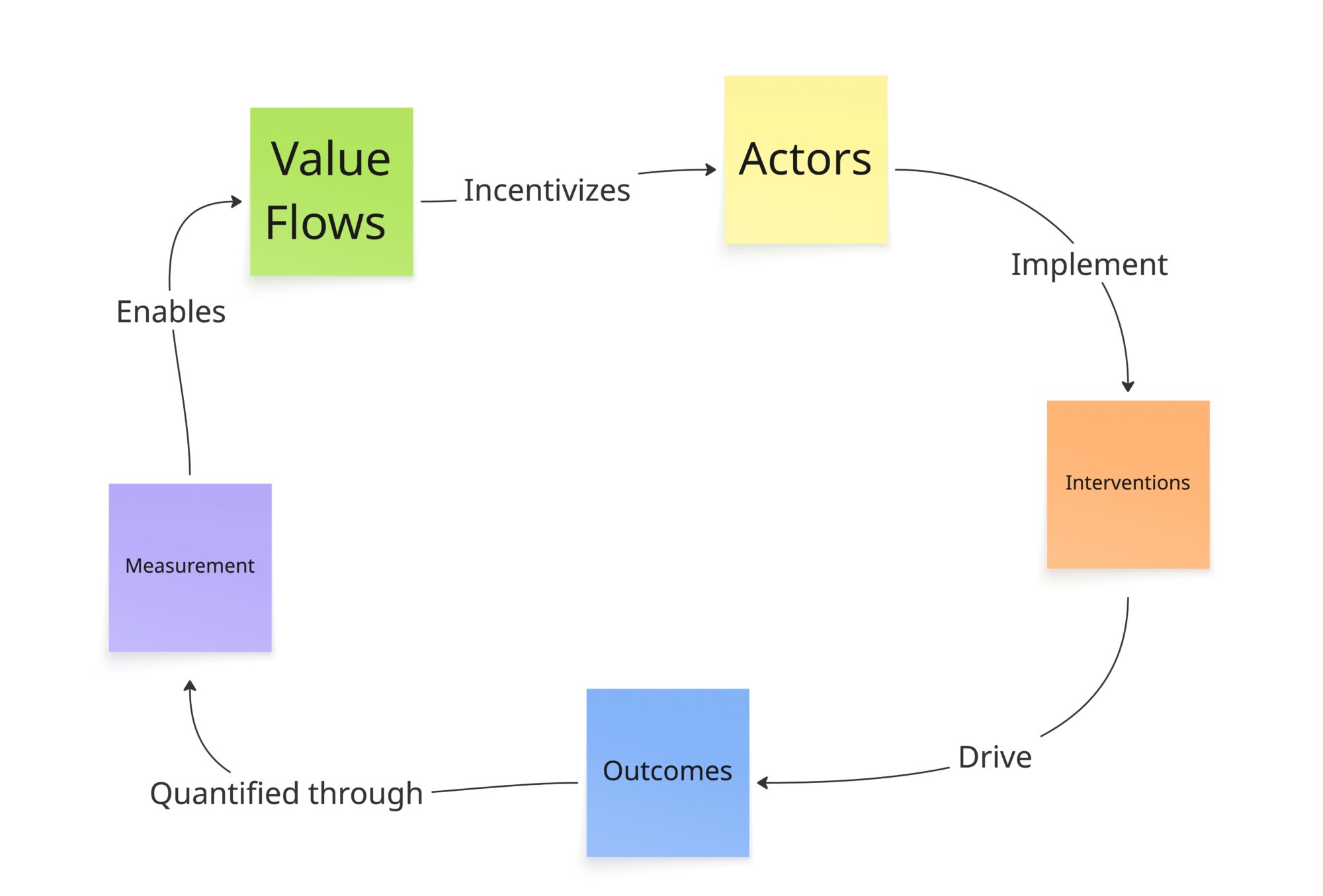
Environmental pathways tend to follow a reinforcing loop:
(Actors → Interventions → Outcomes → Measurement → Value → Actors)
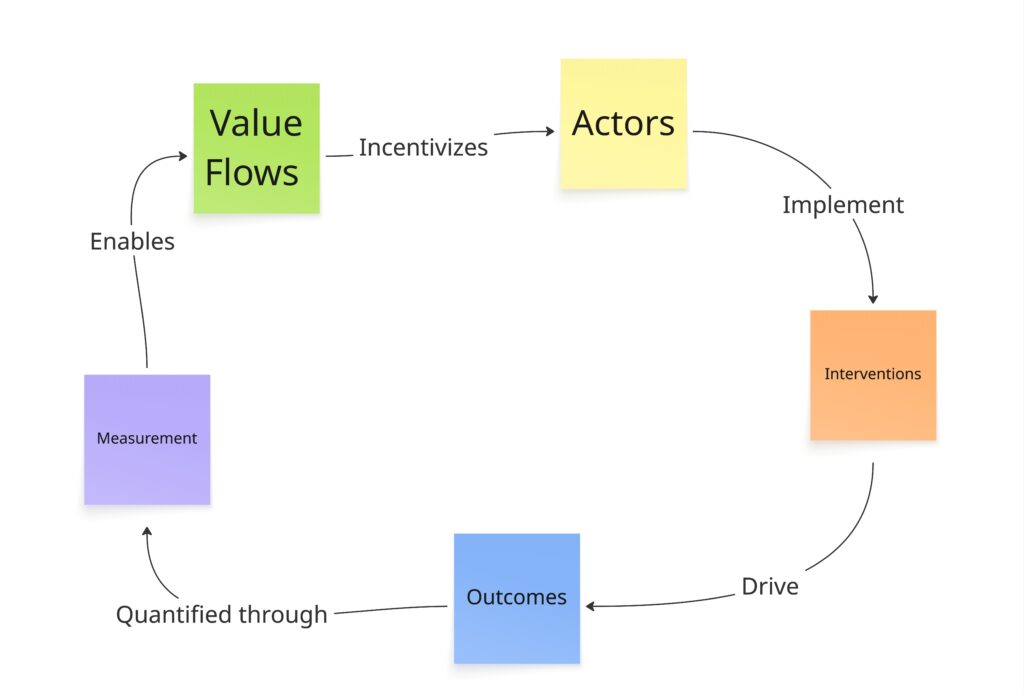
Actors implement interventions that generate environmental outcomes.
Outcomes are measured.
Measurement enables value.
Value creates incentives for actors to continue participating.
When this loop functions, the system reinforces itself.
When it breaks, programs stall.
Making the Architecture Visible
Most environmental initiatives struggle because this architecture is never fully articulated.
Actors operate with partial assumptions about:
• who generates the outcome
• who verifies it
• who ultimately pays
Without clarity, coordination becomes difficult.
And in practice, many programs assume there is only one possible system design.
But each part of the loop can be configured in multiple ways.
Different actors can participate.
Different interventions can generate outcomes.
Different measurement approaches can quantify those outcomes.
Different mechanisms can create value.
Mapping the system makes these choices visible
The Program Design Blueprint
This is why we developed the Program Design Blueprint, a structured way to map how environmental pathways function.
The blueprint helps make the architecture of a system explicit.
Once the actors, interventions, outcomes, measurement approaches, and value flows are mapped, it becomes much easier to see:
• where coordination is required
• where friction exists
• what alternative system designs might be possible
In other words, the blueprint helps turn implicit assumptions into explicit system design.
Designing Systems That Produce Outcomes
Environmental progress will not come from interventions alone.
It will come from designing systems where those interventions can operate effectively.
Systems where:
Participation expands.
Coordination becomes easier.
Measurement becomes cheaper.
Value flows to the actors generating outcomes.
Society becomes more resilient.
In other words: functional “households”
Because the hardest part of climate programs isn’t deploying the intervention.
It’s shifting the system.
If you’re exploring an environmental pathway and want to map how the system works (or could work), you can access the Program Design Blueprint template here.