
Most people think of stakeholder mapping as a communications exercise.
Who should we engage?
Who needs to be informed?
Who has influence?
Who might oppose the work?
That is useful. But for complex climate, agriculture, water, carbon, and supply-chain initiatives, it is not enough.
The harder question is:
Who has to do what differently for this to work?
That question is where a lot of strategies start to get uncomfortable.
The buyer wants the claim, but the supplier owns the data.
The producer is asked to change behavior, but someone else may capture most of the value.
The funder wants outcomes, but the operator carries the execution risk.
The methodology defines the evidence, but not always the incentive.
The strategy sounds coherent until the handoffs become visible.
That is why I think stakeholder mapping should be treated as a system design exercise, not just a communications exercise.
It should help a team see whether the surrounding ecosystem can actually carry the idea.
Why should environmental innovators care about stakeholder mapping?
1. It shows who has to move first
A strategy can sound coherent until you ask who must change behavior.
Someone may need to grow a different crop. Someone may need to buy differently. Someone may need to share data. Someone may need to approve the claim. Someone may need to finance the transition. Someone may need to carry operational risk.
A good stakeholder map makes those required actions visible. It helps identify the linchpins of the system: the actors whose participation determines whether the idea can actually move.
2. It surfaces misaligned incentives
In many systems, the person asked to change is not the person who captures the most value. That is where good ideas get stuck.
The buyer may want the claim. The supplier may own the data. The producer may carry the cost. The funder may want the outcome. The operator may face the risk.
Stakeholder mapping helps identify where value, cost, risk, and responsibility are out of alignment. That matters because a strategy can be environmentally compelling and still be operationally fragile.
3. It keeps you from designing for the wrong user
The person excited about the idea may not be the person whose decision determines adoption. The buyer, funder, implementer, operator, validator, and beneficiary may all be different.
If those roles are blurred, teams can end up designing for the person who likes the concept instead of the person who needs to to use it, pay for it, trust it, or change behavior because of it.
That is one of the quiet ways pilots become dead ends.
4. It clarifies what evidence is actually needed
Different stakeholders need different proof.
A farmer may need economics. A nutritionist may need performance data. A buyer may need sourcing or claims logic. A lender may need risk and asset-value implications. A public agency may need regional outcomes. A funder may need leverage.
This is where measurement can become either useful or burdensome. The point is not to collect more data. The point is to understand what evidence would help the right actor make the right decision.
5. It turns a theory of change into an implementation path
A theory of change can explain why an intervention should matter. Stakeholder mapping helps test whether the system around that intervention can work in practice.
It connects the idea to real decisions, incentives, constraints, evidence needs, risks, and value pathways. That is the difference between a strategy that sounds good and a strategy that can scale.
How we use this in the Program Design Blueprint
In our Program Design Blueprint work, we use stakeholder mapping as one part of a broader operating logic map. The goal is not to make the longest list of stakeholders possible. The goal is to understand who is required for the system to work. That usually means mapping three things (we use AirTable – both because relational databases are cool and useful to structure information and data, AND because they are able to plug into AI reasoning models). Below are three frameworks that we use (and you can copy) in our work to help clients capture value more efficiently.
1. The actor map
Who matters to the system, what role do they play, what do they control, what constrains them, what motivates them, and who do they depend on? This helps reveal the linchpins, blockers, enablers, and overlooked actors.
View AirTable Actor Map template here.
2. The value pathways
How could value actually move through the system?
Who buys, funds, pays, adopts, or benefits? What triggers action?
What is the revenue or value mechanism?
What has to be true for the pathway to work?
What could break it?
This is where you move from “this creates value” to “this creates value for whom, through what mechanism?”
View AirTable Value Pathway template here.
3. The benefit logic per value pathway
This is often the most revealing step.
For each value pathway, we look actor by actor:
Who benefits?
Who pays a cost?
Who carries risk?
Who faces friction?
Who has enough reason to participate?
A pathway can look good in aggregate and still fail because one critical actor has a negative deal. This framework is adapted from Ron Adner’s book The Wide Lens that describes “Value Blueprints”. The graphic below articulates how even though on-net certain innovations might have greater benefit across a system, if one actor has a deficit in the innovation ecosystem, the system will not succeed.
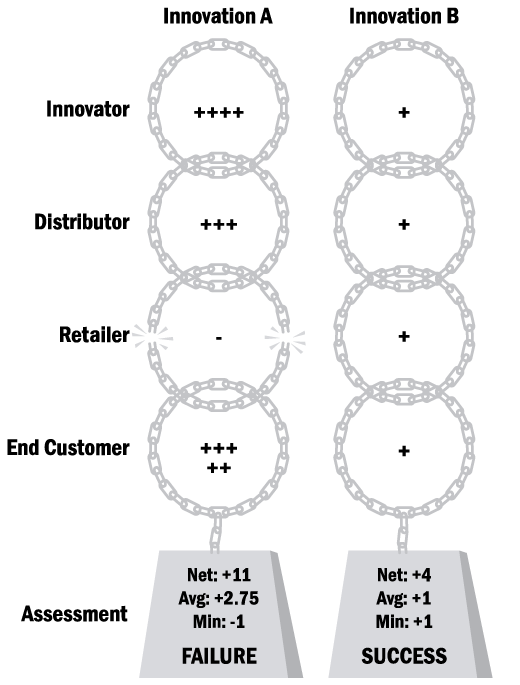
So this mapping approach is where you find out whether the pathway needs better evidence, stronger incentives, technical assistance, risk-sharing, governance, or a different design.
View airtable Value Pathway template here.
The point
Stakeholder mapping is not just about knowing who to talk to. It is about finding the hidden handoffs where good strategies become fragile.
If the buyer wants the claim, the producer carries the burden, the data sits with someone else, and the payment trigger is unclear, the problem is not communications.
The problem is system design.
That is the work we are building into the Program Design Blueprint: a way to make the operating logic visible early enough that teams can see where an initiative is likely to break before they spend a year proving something that still cannot scale.
A note on the templates
The above Airtable views are shared as lightweight, public-facing templates. They are meant to help you see the structure of the framework and pressure-test how it might apply to your own work.
They are not the full Program Design Blueprint system we use with clients. In paid engagements, these tables are usually connected to a broader knowledge base that includes problem maps, decision frames, data dictionaries, hypotheses, evidence, risks, use cases, and project-specific context.
That matters because the value is not just in the table structure. The value comes from using the structure to make better decisions: what to test, who to talk to, what evidence matters, where incentives are misaligned, and where the system is most likely to break.
You are welcome to copy and adapt the templates.
Just know that if you use them on your own, some of the deeper linked logic, AI context value, and project-specific reasoning will not come with the public view.
Why this matters for AI
There is another reason I care about making this structure explicit. AI tools are only as useful as the context you give them.
If your project knowledge lives across meeting notes, slide decks, spreadsheets, PDFs, Slack threads, and people’s heads, AI can summarize fragments, but it will struggle to reason well about the system.
A structured knowledge base changes that.
When actors, value pathways, evidence, assumptions, risks, and use cases are mapped clearly, AI becomes much more useful as a reasoning partner.
A few weeks ago, I demonstrated this live using Airtable with AI tools that can read from and write to structured project tables. The time savings are real. But the bigger benefit is not speed.
It is better reasoning.
The framework gives the model better context.
The human still has to decide what matters.
Want help applying it?
The templates can help you see the pieces.
The conversation can help you see where the system is breaking.
If you’re working on a climate, agriculture, water, carbon, supply-chain, AI knowledge-base, or environmental value initiative where the actors, incentives, evidence, and value flows are getting messy, I’m offering a few short Program Friction Scans.
It’s meant to be a focused conversation to identify where the operating logic may be incomplete, and whether a fuller Program Design Blueprint would help.